

April 2026 Vol. 1, No.4
Trouble in Paradise

Back on course, Bucephalus again turned in the direction of Sleepy Hollow with hopes we would be there before pumpkins ripen. It seemed that my old friend (MOF in the last essay) had helped define the concept of garden, a bounded space, product of man, providing succor for the soul and body. Eight hundred miles of winding roads separated us from the land of Washington Irving’s Ichabod Crane, surely enough time to solidify thoughts on gardens. However, the rude hills of Eastern Kentucky and West Virginia did little to instill any sense of beauty or exalt a spirit of erudition. Great tailings on a dead landscape marked more than a century of mining where husbands and fathers succumbed to failing lungs from the dust of the coal that fired coke furnaces in Pennsylvania, Ohio and Michigan. Generations had been deprived of health, education and economic adequacy. Did towns like Pikeville, Tug Fork and Matewan ever see the colors of sweet peas or climbing roses? Did town parks, clear brooks and the plantings of a stroll garden ever offer an hour’s respite for the poorly clad, poorly schooled children of toil? Did well stocked libraries brighten the minds of inquisitive scholars to read Darwin, Whitman or Shakespeare? Damned few.
Bucephalus crawled over this scarred wasteland but brought me no nearer understanding. I thought of the saddlebag librarians of Kentucky, proud, helpful volunteers who carried books and magazines to the curious. For those lucky few, some may have learned to read and perhaps dream, but malnutrition of the mind remains with us today in the hordes of the deprived, victim to fundamentalist religious assaults on the human spirit. Pot boilers of vitriol do their best to spread intolerance, hatred, and vindictive denial of basic rights. The further we drove into those mountains of squalor, the madder I grew. Where is the human spirit, wonder for the beauty of nature, the desire to learn, the quest for understanding? Not here. But the horseback librarians told me that anything is possible with a bit of nurturing. Bucephalus had no radiator to boil over, but he was uncomfortable in these hills of ignorance and want. We needed to find something uplifting. With determination we reversed direction and headed towards the Lan Su Garden in Portland.
What does a Ming dynasty style Chinese garden built in the American West have to say about the impoverished people in want from Hatfield/McCoy territory where a hundred years ago, a third could not sign their names? Bucephalus followed the best and straightest byways. We speed along at 50, dallying but time enough to gaze at the fields of winter wheat in northern Kansas and the fast-melting snows of the Bitterroots.
Sixty-five artisans from Suzhou brought five hundred tons of stone plus their talents to construct the most authentic Ming style garden outside of China. Near the banks of the Willamette River, in Portland's historic district, a block square garden was created, a walled enclosure with pond, pavilion, scholar’s study plus a tea house. Here, this jewel, a contemplative oasis, is distilled into the essence of garden. Bucephalus delivered me there on a rainy morning with a chill in the air and low-lying clouds shrouding the city's financial district. Entering took me away from the outside world. Stuccoed walls capped by grey terracotta tiles defined an enclosed space, a safe environment, a Locus amoenus. Stepping over a boundary defining

sill and through an imposing gate placed me in a cloistered courtyard with rocks, plantings and inner walls that required further study. This heightened the anticipation of what is hidden. Choice presents itself. Climb a few steps on the left into a flower pavilion or straight ahead through a second gate. A stand of bamboo, a stone monolith and a narrow pathway did not easily yield their secrets. Conflicted, should I stop and gaze or rush to the unknown? Impetuous, I made my way to the scholar’s study, saving contemplation of stone pavements, koi fish and an arched bridge for later. This retreat focused attention on shadows, tiled walls and half open shutters, an uncluttered space, inviting contemplation. Bucephalus had delivered me into a distillation of what one seeks that excludes the superfluous and concentrates attention.
I am at peace. Daily concerns vanish. The long list of to do’s, of supposed responsibilities, of expectations, of all that adds to distraction, these assaults upon tranquility I thrust aside. But the beauty of solitude is so delicious that soon I find myself conflicted. Ought not such a special moment be shared? But does not sharing destroy the quiet that is sought? Such thoughts never bring resolution and within half an hour I wander over to the tea house for steamed buns and subtle oolong. A peony pavilion’s tiled roof is reflected off a koi pond shrouded by a willow touching the pond’s surface. This space is magical, but might be enhanced by the perspective from the tea house’s second floor. Climbing stairs does command a view of the entire garden, covered pathways, a rock grotto with waterfall, plum trees, camellias and the imposing protective wall that defines the space. Yet I find more than expected. Crossing this upper room, a second view emerges. Shuttered windows had been flung open. Over garden walls, I see beyond. I see what has been excluded.
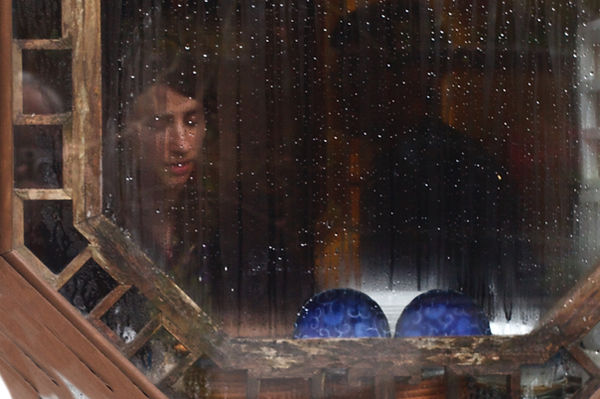
What I see is disturbing. And what disturbs is that which I have ignored. Should I wear a coat of shame? Below stretches a hodgepodge of tents, cardboard boxes and tarpaulins, plus the detritus of neglect. Below is a sea of the dispossessed, people fallen upon hard times, victims of mental illness, addiction and bad luck. Sidewalks, doorways and vacant lots are cluttered. The neighborhood is in shambles. Most storefronts are boarded, automobile parking spaces usurped and garbage receptacles strangely in want. I see no toilets, water faucets nor covered spaces to protect from the elements. Squalor blankets all. Movement is in slow motion. Blank, unwashed faces, people from whom any sense of dignity has been stripped are caught
in the City of Roses overrun by thorns of neglect. Did city fathers ever anticipate the needs of so many and our unpreparedness? Is any power capable of shoring up this terrible social collapse? I have no answers. I am numbed. What can be done in an era where wealth is plentiful and food abounds? Somehow, we have lost our way. Opportunities are presented to the prepared, the fortunate, those with families and environments that nurture growth. If you fit the mold, if you sidestep setbacks and have perseverance, success is probable. But even in the best brickyard, clinkers occur. Not everyone wins. You don't get to choose your parents, your ethnicity, nor your place of conception. Sometimes you are branded before birth, denied health, a safe place to grow or opportunity to blossom. And unfortunately, society is intolerant, quick to point fingers, eager to cast blame and often callous enough to deny a helping hand to those in need. Thus, our cities fester with the consequences of social inadequacy. Those despoiled by mental illness, drug addiction, disease and lack of support to recover from life's mistakes fall into tent cities, squalor and the destruction of any sense of self-worth. I look out over a sea of deprivation from the protected confines of a soothing, beautiful sanctuary. This cannot be the last word. Gazing over towards the Columbia River, the words of Sam Cook’s “A Change Gonna Come” ring true, “and just like the river I've been runnin’ ever since”. Perhaps the nurturing power of the garden can invigorate thoughts to find something positive. If I intend to continue to put thoughts to paper, there had better be something worthy of recording. The garden is an oasis to come to, to rest, to exclude, to concentrate thought, to allow the mind to wander while resting the body. But once rested, the open gate leads outwards. Bucephalus waits. There's a long road before us. There is much to see. Richness abounds but we carry a responsibility.

Dustan Osborn
Dustan Osborn, member of the Board of Trustees of the Hammond Museum and Japanese Stroll Garden, is a practicing medical oncologist in Washington state. After earning a PhD in Biophysics, he attended medical school, then completed an oncology fellowship at Harvard’s Dana Farber Cancer Center. His avocational interests include photography, old books, and the history of scholarship. He is on the prowl for hole-in-the-wall eateries and interesting places where the crowds don’t go.